
- Contents
Calculate support settlement
Did you know that you can use Consteel to calculate support settlement?
Settlement verification is an essential part of designing pad foundations, ensuring that the vertical displacement under service loads does not compromise the structural performance. Consteel allows engineers to perform these checks directly within the model, fully aligned with EN 1997-1:2004 (Eurocode 7), Section 6.6.2.
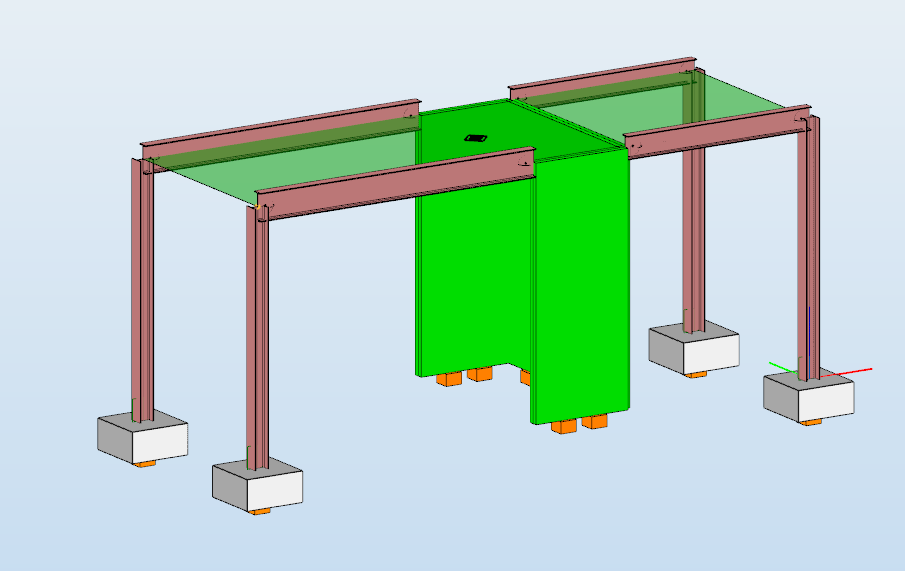
According to Eurocode 7, the procedure is based on evaluating the deformation of the supporting soil due to applied loads. This requires defining the soil profile with appropriate deformation parameters and determining the distribution of vertical stresses beneath the foundation. The calculation is performed over the depth where the load-induced stress increase remains relevant compared to the in-situ stress conditions.
The resulting deformation is obtained by considering the compressibility of the soil layers and, where necessary, the time-dependent behavior of fine-grained soils. The calculated total settlement is then assessed against allowable limits defined for the structure, ensuring that serviceability criteria related to deformation and functionality are satisfied.
The software allows the user to define the key parameters affecting settlement:
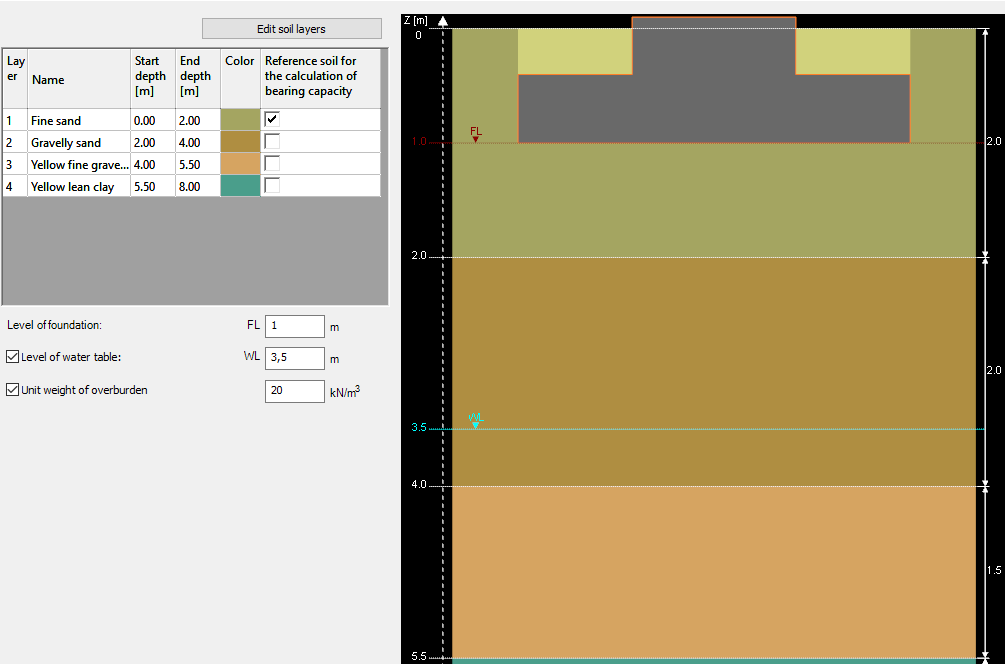
- Soil profile: Each layer’s thickness and deformation modulus can be specified to represent compressibility and stiffness.
- Settlement limit: Allowable settlement values can be set to check serviceability.
- Drained or undrained conditions: The calculation can consider short-term or long-term soil response.
- Water table level: Groundwater depth can be defined, affecting effective stresses and settlements.
Before performing settlement verification, ensure that the necessary load combinations are included in the structural model. Consteel calculates reaction forces at the footing level for the Serviceability Limit State (SLS) combinations. These reactions are then used to evaluate settlement as part of the foundation checks.

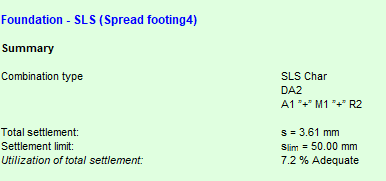
Consteel performs total settlement checks for each spread footing. The software provides:
- Total settlement value under SLS loads
- Allowable settlement limit according to design criteria
- Utilization ratio (the proportion of allowable settlement used by the calculated settlement)
This information allows engineers to verify whether the foundation satisfies serviceability requirements and determine if adjustments to footing dimensions, reinforcement, or soil treatment are necessary.
Consteel integrates settlement verification with other foundation design checks, including:
- Soil bearing verification (EN 1997-1 Annex D)
- Sliding and overturning (EN 1997-1 Sections 6.5.3, 6.5.4; EN 1990 Section 6.4.2)
- Reinforcement bending (EN 1992-1-1)
- Punching shear (EN 1992-1-1 Section 6.4.4)
Any modification to the footing geometry or structural loads automatically triggers a reanalysis, ensuring that settlements are always calculated accurately.
By integrating settlement calculations with the design workflow, Consteel allows engineers to check pad foundations for serviceability directly within the model. Total settlement, limits, and utilization ratios are clearly presented, enabling efficient verification of Eurocode 7 requirements without additional manual calculations.
Download the example model and try it!
Download modelIf you haven't tried Consteel yet, request a trial for free!
Try Consteel for free