fbpx

Let's see the program for this year’s International Consteel Meetup! Take a look and register for the event before 13 May.

ES

Seismic design of steel halls

Is a single dominant vibration mode sufficient, or should multiple vibration modes be considered in seismic analysis?

Steel portal frames are frequently used in industrial and logistics buildings as primary load-bearing structures. Their seismic behavior is strongly influenced by the stiffness of the roof diaphragm and by the interaction between the main portal frames and secondary structural subsystems such as endwalls.

In seismic design, engineers often assume that the global response of such buildings can be represented by a single dominant vibration mode. This assumption is valid when the roof diaphragm is sufficiently rigid and the first transverse mode mobilizes most of the structural mass. However, when the diaphragm is flexible or when different structural parts participate in different vibration modes, higher modes may also contribute to the seismic response.
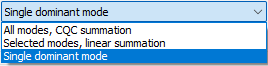
Figure 1: Available calculation methods in Consteel for seismic effects

This article investigates how the choice between a single-mode and a multi-modal approach affects the seismic design of steel halls modeled in Consteel. Through a comparative example, the study demonstrates the implications of different modal combination techniques and discusses how reliable internal forces can be obtained while maintaining compatibility with stability verification procedures according to EN 1993-1-1.

Case with a Rigid Roof Diaphragm

Single dominant mode

If a building is designed with a sufficiently rigid roof diaphragm, a single transverse vibration mode is typically able to mobilize close to 90% of the total participating mass. In such cases, the Single dominant mode method is an efficient and preferred design method.

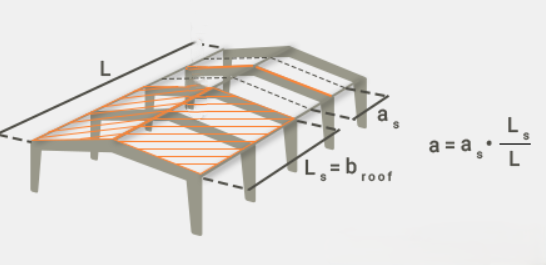
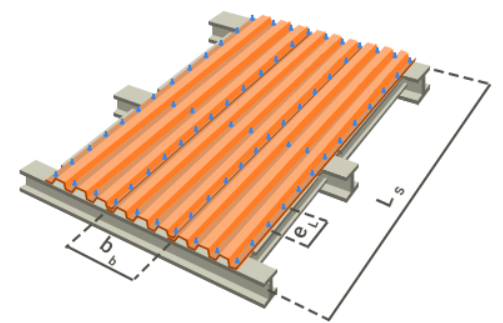
Figure 2: Applicable effective width [m] for shear stiffness

A rigid roof diaphragm can be achieved by:

  • Using an adequate trapezoidal steel deck, modeled in Consteel either
    • as a Shear Field with a high shear stiffness parameter (“S” value), or
    • by introducing equivalent dummy roof bracing diagonals with rod diameters calibrated to reproduce the diaphragm shear stiffness.
  • Alternatively, real bracing elements may be added along the sidewall columns or from the eaves to the ridge along the building length.

Case without a Rigid Roof Diaphragm

If a rigid diaphragm is intentionally not assumed, a single vibration mode will generally not represent the full seismic response in the transverse direction.

Single dominant mode

A dynamic eigenvalue analysis is first performed to determine the natural vibration modes of the structure. In Consteel, this analysis calculates the eigenfrequencies and corresponding mode shapes based on the structural stiffness and mass distribution, considering both the elastic stiffness and second-order geometric stiffness of the structure. The first three vibration modes are then evaluated for their mass participation in the transverse direction.
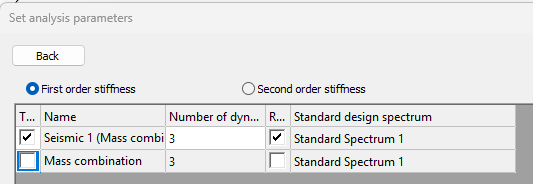
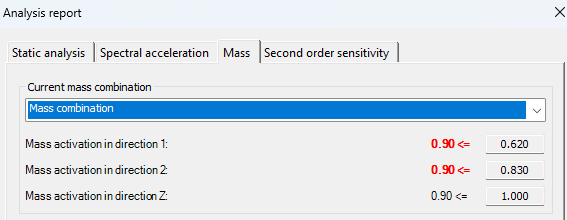
Figure 5: Analysis report, Mass

After the calculation, the mass participation for each principal direction (X, Y, and Z) can be viewed in the Analysis tab under the Analysis report, in the Mass section. In the examined case:

  • The first vibration mode is dominant in the transverse direction.
  • It mobilizes only 62% of the total participating mass.
  • This is below the 90% minimum requirement specified by EN 1998.

As a result, additional vibration modes must be considered to accurately capture the seismic response of the structure.

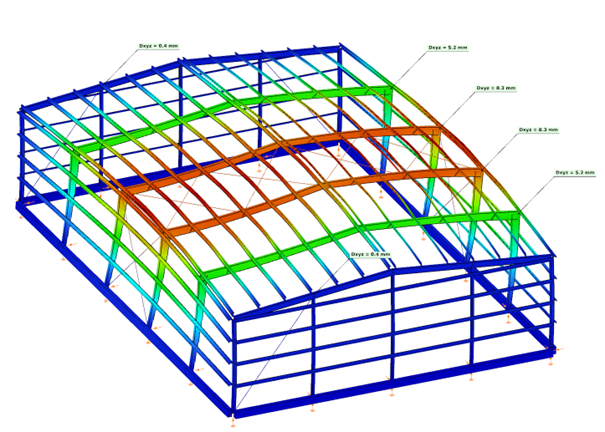
Figure 6: Dynamic shape - XYZ

If only the first mode were used:

  • The seismic action in the middle portal frames would be reasonably captured.
  • More rigid structural parts (e.g. endwalls), insufficiently mobilized by the first mode, would not be properly represented.

When the Single dominant mode method is applied, Consteel automatically scales the first mode to represent 100% mass participation, regardless of the dynamic analysis result, as a measure the predict the effect of uncalculated and therefore missing modes. In this case this results an overestimation of 1.00/0.62=1.61 of the internal forces for the middle frames.

See bending moment diagrams obtained from 62% modal mass (Fig. 7) and from overestimated 100% mass (Fig. 8) considered in single dominant mode of Consteel.

Figure 7: Bending moment diagram from the first mode (62% mass participation)
Figure 8: Bending moment diagram for the summed results (Single dominant mode)

Download the example model using the single dominant mode method:

Download model

All modal shapes, CQC summation

Since 90% of the participating mass is not achieved with the first modes, additional modes must be calculated. After increasing the number of computed modes to 25, the total participating mass in the transverse direction exceeds 90%.

In Consteel, modal loads are calculated for all dynamic shapes in all directions, and first-order analysis is used to determine displacements and internal forces for each mode. The Complete Quadratic Combination (CQC) method then summarizes these results. This Eurocode-recommended statistical method produces envelope diagrams of deformations and internal forces (without signs), representing the highest expected values.

Figure 9: Subpage of dynamic analysis for CQC
Figure 10: Analysis report, Mass CQC

Key aspects of the Complete Quadratic Combination (CQC) method:

  • Modal internal forces are combined non-linearly.
  • All resulting modal combinations are positive by definition.
  • Final bending moment and axial force envelopes are obtained.

Limitations:

  • The envelope results from a non-linear modal superposition.
  • An equivalent linear load case producing identical results cannot be created.
  • Therefore, linear buckling analysis with critical load multipliers corresponding exactly to the CQC envelope is not possible.
  • Consequently, the advanced stability design method in Consteel (based on elastic buckling modes and the General Method of EN 1993-1-1) cannot be directly applied.
Figure 11: Bending moment diagram for CQC
Figure 12: Axial force diagram for CQC

Download the example model using the all modal shapes, CQC summation method:

Download model

Selected modes, linear summation

Using the “Selected modes, linear summation" method in Consteel, selected vibration modes can be combined linearly. Relevant modal shapes are defined together with combination factors for each mode, and the software generates equivalent modal loads from the resulting combined vibration shapes. This is a technique used to approximate non-linear modal combinations by adequate linearized modal combinations.

From modal evaluation, the following modes are identified as globally relevant:

ModeMass participation
10.62
40.08
340.17

These three modes are largely independent.

Mode 4 produces bending moments with opposite signs in certain members; therefore, two combinations are defined:

  • Combination 1: +1 · Mode 1, +1 · Mode 4, +1 · Mode 34
  • Combination 2: +1 · Mode 1, −1 · Mode 4, +1 · Mode 34
Figure 13: Load cases and load groups
Figure 14: Linear combination of modal effects

The resulting combined modal shapes generate linearized equivalent seismic load cases that can be used in the subsequent structural analysis.

After the dynamic analysis and the first-order linear static analysis of the generated equivalent modal forces, the envelope of the resulting linearized seismic load cases provides the bending moments in the portal frames and the axial forces in the endwall members.

Figure 15: Bending moment diagram for Selected modes, linear summation, modal combination 1
Figure 16: Axial force diagram for Selected modes, linear summation, modal combination 1
Figure 17: Bending moment diagram for Selected modes, linear summation, modal combination 2
Figure 18: Axial force diagram for Selected modes, linear summation, modal combination 2

This approach avoids the non-linear CQC modal combination and instead uses a linear combination of selected modal results. As a result, the seismic effects are represented by equivalent linear load cases, which allows the application of the standard stability verification procedures in Consteel, including linear buckling analysis and the General Method according to EN 1993-1-1.

Download the example model using the selected modes, linear summation method:

Download model

Summary

The following table shows the bending moments from the horizontal seismic action (without the effect of other permanent loads included in the seismic combination) obtained in portal frames using the various approaches by Consteel

Bending moment [kNm]
 Single dominant modeCQCSelected modes
combination 1combination 2
Frame 114.7710.4012.554.19
Frame 224.2915.1012.7117.78
Frame 324.1415.0212.6617.68
Frame 414.7510.3912.654.18

Maximum utilization ratios considering global buckling

Highest ratioSingle dominant mode [kNm]CQCSelected modes
Frame 10.34-0.33
Frame 20.39-0.36
Frame 30.39-0.36
Frame 40.34-0.33

Similar comparison for the axial tension forces in the diagonal members of the endwalls

Bending momentSingle dominant mode [kNm]CQCSelected modes
   combination 1combination 2
Endwall2.827.389.646.45

Conclusion

The Single dominant mode method provides:

  • A fast solution
  • Conservative internal forces for the most dynamically sensitive members (e.g., intermediate portal frames)

Limitations:

  • For structurally stiffer subsystems with different dynamic characteristics (e.g., endwalls), results may be inaccurate and potentially unsafe.

The Selected modes, linear summation method:

  • Approximates the CQC multi-modal response with linearized equivalent modal load cases.
  • Enables stability verification using:
    • Linear buckling analysis
    • General Method (EN 1993-1-1)
  • Provides results close to the CQC reference while maintaining compatibility with standard design workflows.

This makes it a technically consistent solution when multiple transverse vibration modes must be considered but linear stability design procedures are required.

The use of 1-2-1 scale factors represents a simplified approach that is usually adequate for industrial halls. For a more complex Consteel example, see the Seismic design of frames of single-story industrial building with built-in mezzanine floors according to Eurocode 8 with Consteel article.

Static analysis
EN 1993-1-1
Model examples
Technical studies
User guides
Seismic
Seismic design

El autor

Bálint Vaszilievits-Sömjén

Head of R&D Group of Consteel, responsible for the coordination of development of new software features, research tasks. Preparation of webinars and keep international contact with partners involved in Consteel development.